Readers should know CATL, BYD, Pylontech, Sungrow, Huawei, and Pinergy. This comparison weighs quality, price, technology, warranty, and customer support. China leads global production, so these Solar Battery Manufacturers matter. The guide helps match a manufacturer to home, business, or off-grid needs.
Key Takeaways
-
CATL and BYD lead the market with advanced technology and large-scale production.
-
Pylontech and Pinergy offer reliable home batteries with strong warranties and support.
-
Always check certifications, warranty terms, and local support before buying.
Top Solar Battery Manufacturers In China
Quick Comparison Table
The table below summarizes ten leading Chinese solar battery manufacturers. Rankings reflect 2025 global energy storage system shipment data where available.
|
Company |
ESS Cell Supplier Rank |
Global Share |
Primary Strength |
|---|---|---|---|
|
CATL |
#1 |
28.5% |
LFP and sodium-ion cells |
|
BYD |
#4 |
10.5% |
Vertical integration |
|
CALB |
#5 |
7.1% |
Cell supply partnerships |
|
Pylontech |
Not ranked |
Not available |
Residential LFP storage |
|
Sungrow |
Not ranked |
Not available |
Hybrid and commercial systems |
|
Huawei |
Not ranked |
Not available |
Smart energy management |
|
Dyness |
Not ranked |
Not available |
Compact home batteries |
|
GoodWe |
Not ranked |
Not available |
Inverter-battery pairing |
|
Avepower |
Not ranked |
Not available |
Niche OEM production |
|
Pinergy |
Not ranked |
Not available |
Residential support focus |
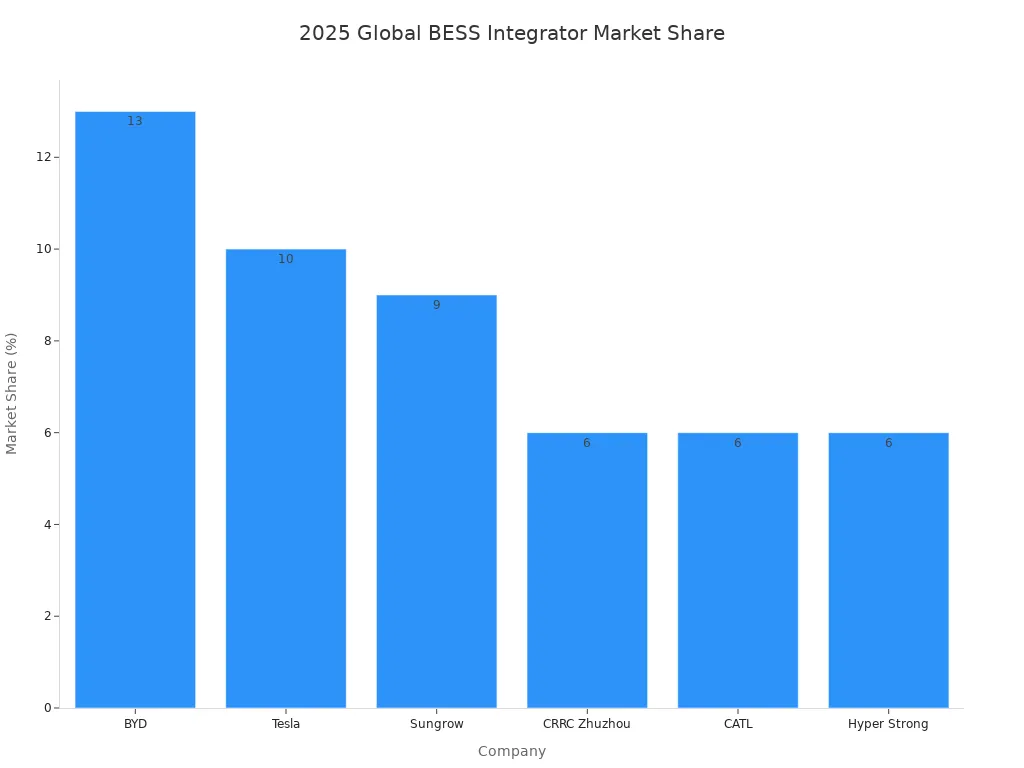
BYD overtook Tesla as the world's top BESS deployer in 2025. BYD shipped over 60 GWh while Tesla deployed 46.7 GWh. Sungrow ranked third among system integrators, with BESS contributing 42% of total revenue. CATL remained the top cell supplier but saw its share drop from 29% in 2024 to 20% in 2025.
How We Evaluated Them
This comparison applies five criteria. Each one matters differently depending on the buyer's project.
Product quality covers cell chemistry, build standards, and safety certifications. A reliable lithium battery supplier China based operation should document its testing protocols clearly.
Price reflects the upfront cost per kilowatt-hour and the total cost of ownership. LFP pricing has fallen across the board, which shifts the math for buyers comparing budget and premium options.
Technology includes battery chemistry, depth of discharge, round-trip efficiency, and smart features. Sodium-ion research at CATL and LFP refinement at BYD represent two different technology paths.
Warranty length and terms vary widely. Some manufacturers offer ten years, while others provide five. The warranty document itself often reveals how confident a company is in its product.
Customer support covers responsiveness, local service networks, and technical documentation. An ESS manufacturer China based company with regional offices typically responds faster to warranty claims.
Each manufacturer on this list competes on different combinations of these five factors. No single company wins on every criterion. The right choice depends on whether a buyer prioritizes upfront savings, long-term reliability, or local support access.
CATL And BYD: Market Leaders
Pros, Cons, And Best Uses
CATL and BYD stand as the two most important Chinese solar battery companies. Both companies shape global pricing and technology trends. Each one follows a different strategy.
CATL leads in LFP and sodium-ion research. The company invests heavily in next-generation chemistry. Sodium-ion cells promise lower cost and better cold-weather performance. CATL's scale gives it strong bargaining power with raw material suppliers. Its weakness lies in direct consumer support. The company primarily serves other manufacturers rather than end users.
BYD controls its supply chain from cell production to finished battery packs. This vertical integration lowers costs and improves quality control. BYD also reaches global markets through electric vehicles and energy storage projects. The company overtook Tesla as the world's top BESS deployer in 2025. BYD shipped over 60 GWh while Tesla deployed 46.7 GWh. Its premium pricing and complex product lineup can confuse smaller buyers.
|
Company |
2025 Global BESS Integrator Market Share |
|---|---|
|
BYD |
13% |
|
Tesla |
10% |
|
Sungrow |
9% |
|
CRRC Zhuzhou |
6% |
|
CATL |
6% |
|
Hyper Strong |
6% |
Expert Recommendation
Buyers seeking cutting-edge chemistry should watch CATL. The company's sodium-ion progress could reshape the market within a few years. However, CATL works best for large-scale projects and OEM partnerships. A residential buyer rarely deals with CATL directly.
BYD suits buyers who want a proven, integrated system. The company's global service network supports international projects well. Its track record in both vehicles and storage builds confidence. For most commercial and utility-scale projects, BYD offers the stronger complete package. CATL remains the technology leader, while BYD delivers the better end-to-end experience.
Pylontech, Sungrow, And Huawei
Pros, Cons, And Best Uses
Pylontech built its reputation as a verified LFP supplier for residential storage. The company focuses on lithium iron phosphate batteries for home systems. Its products pair well with most major inverters. Homeowners value the simple installation and stable performance. Pylontech batteries also carry strong safety certifications. The main drawback involves limited support for very large commercial projects. The company targets residential users rather than utility-scale buyers.
Sungrow and Huawei serve commercial and hybrid systems well. Sungrow combines inverters with battery storage for seamless energy management. The company ranked third among global system integrators in 2025. Huawei offers smart energy management through its FusionSolar platform. Both brands suit businesses that need integrated hardware and software. Huawei faces cybersecurity scrutiny in some markets. Several countries have restricted Huawei equipment in critical infrastructure. Buyers in those regions should check local regulations before purchasing.
Expert Recommendation
Pylontech suits homeowners who want a proven, affordable battery. The brand works best for standard residential installations. Buyers seeking a reliable lithium battery supplier China option for home use should shortlist Pylontech first.
Sungrow fits commercial projects that need strong inverter integration. Huawei appeals to buyers who prioritize smart monitoring and hybrid system control. However, buyers in markets with Huawei restrictions should consider Sungrow instead. Both companies rank among the top Solar Battery Manufacturers for business applications. The final choice depends on local regulations and project scale.
Pinergy And Other Rising Brands
Pros, Cons, And Best Uses
Pinergy earns attention as a reliable residential storage brand. Homeowners receive strong customer support, including responsive support and clear warranty claims. The company concentrates on plug-and-play battery systems that work with common hybrid inverters. This simplicity attracts users who want dependable storage without complex configuration. Its main limitation involves minimal utility-scale experience.
Dyness and GoodWe occupy the mid-tier market with distinct advantages. Dyness produces compact home batteries for tight spaces. GoodWe pairs its batteries with its own inverters for seamless communication. CALB ranks fifth in global ESS cell supply, yet it sells cells to manufacturers rather than directly to homeowners. Avepower focuses on niche OEM production, allowing other brands to rebrand its battery packs.
Custom battery projects require a different route. OEM manufacturers such as HBOWA NEW ENERGY build packs according to buyer specifications. These factories handle cell sourcing, BMS integration, and finished packaging. A company can launch its own branded battery this way. Custom orders typically demand higher minimum quantities. The buyer takes responsibility for technical support and warranty servicing.
Expert Recommendation
Residential users valuing reliability and after-sales support should shortlist Pinergy first. The brand suits homeowners seeking a dependable system without complex engineering. A solid warranty with responsive service outweighs a longer promise from a manufacturer with weak local support.
Niche needs call for a tailored approach. Dyness fits compact residential retrofits. GoodWe matches projects already using its inverters. CALB serves OEMs and large-scale integrators. Avepower suits brands seeking white-label production. Buyers comparing a lithium battery supplier China should request cell origin and cycle-life documentation. An ESS manufacturer China should provide inverter compatibility data. Buyers should also secure a warranty service agreement from a local distributor when the factory lacks a regional office.
Price Comparison
Budget, Mid-Range, And Premium
Chinese solar battery pricing splits into three broad tiers. Budget options come from niche OEM factories and white-label producers. These packs cost the least per kilowatt-hour, yet they often lack documented cycle-life testing. Mid-range brands such as Pylontech, Dyness, and GoodWe balance cost with verified safety certifications. Premium systems from BYD, Sungrow, and Huawei carry higher upfront prices. Buyers pay extra for integrated software, global service networks, and longer warranty terms.
|
Tier |
Example Brands |
Typical Trade-Off |
|---|---|---|
|
Budget |
Avepower, white-label OEMs |
Lower upfront cost, thinner documentation |
|
Mid-range |
Pylontech, Dyness, GoodWe |
Certified cells, moderate support |
|
Premium |
BYD, Sungrow, Huawei |
Integrated systems, global service |
LFP pricing has fallen across the board, and this trend reshapes buyer decisions. A homeowner who once chose budget cells can now afford certified mid-range packs. Falling cell prices also compress the gap between tiers. A lithium battery supplier China that once competed on price alone must now compete on support and documentation.
Hidden Costs To Watch
The sticker price rarely reflects the true cost of ownership. Shipping lithium batteries requires dangerous goods handling, which adds freight surcharges. Installation demands a qualified electrician familiar with hybrid inverter wiring. Warranty claims may require return shipping to the factory, and that cost often falls on the buyer.
An ESS manufacturer China with no regional office leaves servicing to local distributors. Those distributors charge labor rates the factory never quotes. Buyers should request a landed-cost breakdown before committing. Ask for shipping, installation, and warranty-service estimates in writing. A cheap battery with expensive servicing often costs more over ten years than a premium pack with local support.
Quality, Technology, And Warranty
Battery Chemistry And Cycle Life
LFP remains the dominant chemistry among Chinese solar battery manufacturers. Sodium-ion has emerged as a serious alternative. CATL's Naxtra cells deliver 175 Wh/kg at cell level, matching mainstream LFP. The company also claims 10,000+ cycles at 80% capacity retention under GB 38031-2025 certification.
|
Feature |
LFP (LiFePO₄) |
Sodium-ion (Na+) |
|---|---|---|
|
Energy density (Wh/kg) |
90–160 |
70–160 |
|
Cycle life (to 80% capacity) |
3,000–7,000 |
2,000–5,000 |
|
Thermal runaway temp |
>270°C |
>300°C |
|
−20°C capacity retention |
75–85% |
85–92% |
|
Raw material risk |
Low (Fe, P, Li) |
Very low (Na, Fe, Mn) |
Sodium-ion offers clear safety benefits. Nail penetration tests produce peak temperature rises 40–60°C lower than comparable lithium cells. Cold climates favor the newer chemistry, with stronger capacity retention at −20°C. Fire suppression system costs drop 15–20%. Raw material risk falls too, since sodium, iron, and manganese are abundant.
Warranty And Customer Support
Warranty terms vary widely across manufacturers. Pylontech offers 10 years with 6,000 cycles at 95% depth of discharge. Sungrow matches that length and guarantees 8,000 cycles. BYD specifies 6,000 charge/discharge cycles without a stated warranty period.
|
Brand |
Warranty Length |
Throughput/Cycle Guarantee |
|---|---|---|
|
Pylontech |
10 years |
6,000 cycles at 95% DoD |
|
Sungrow |
10 years |
8,000 cycles |
|
BYD |
Not specified |
6,000 charge/discharge cycles |
Buyers should demand stronger terms. A throughput warranty expressed in MWh beats a simple cycle count. Guaranteed capacity retention of at least 70% at the end of the term protects the investment. The manufacturer must back the warranty directly, not a third-party installer.
An ESS manufacturer China with regional offices processes claims faster. A lithium battery supplier China without local presence leaves the buyer organizing cross-border shipping. Support responsiveness ultimately matters more than a long paper promise.
Trust Concerns And Buyer Skepticism
Quality And Geopolitical Risks
Some buyers, particularly Australians, question whether Chinese batteries match Western brands on quality. These concerns often stem from early budget imports with thin documentation. Today, most major manufacturers hold international safety certifications and publish cycle-life test data. A reputable lithium battery supplier China operation will share cell origin, testing protocols, and third-party audit reports on request. Buyers should treat missing documentation as a warning sign rather than proof of poor quality.
Geopolitical risk affects long-term ownership in subtler ways. Trade restrictions can interrupt spare parts supply or delay warranty replacements. A manufacturer cut off from a market may leave existing customers without firmware updates or service. Buyers in politically sensitive regions should favor brands with regional offices and local distribution partners. An ESS manufacturer China with a strong local presence reduces this exposure considerably.
Cybersecurity And Data Safety
Smart batteries connect to apps, inverters, and sometimes the grid itself. That connectivity creates real security questions. Forescout's SUN:DOWN research in March 2025 catalogued 46 new vulnerabilities across Sungrow, Growatt, and SMA equipment. Reuters reported in May 2025 that undocumented cellular radios existed inside Chinese-made inverters and batteries deployed in the United States. The November 2024 Deye event remotely disabled inverters across the US, UK, and Pakistan. That incident was commercially motivated, yet it demonstrated live kill-switch capability.
Manufacturers have responded with stronger security measures. Sungrow partnered with TÜV SÜD to build a "zero trust" architecture and passed ISO/IEC 27001 certification. Huawei published an inverter security white paper disclosing core technical parameters. The EU now promotes the mandatory EN 50178 standard, which adds certification barriers and can extend test cycles by three to six months. Buyers should verify which certifications a system carries before purchase. They should also ask whether the manufacturer allows local data storage and independent security audits.
Which Solar Battery Manufacturers Fit Your Needs
Best For Home Energy Storage
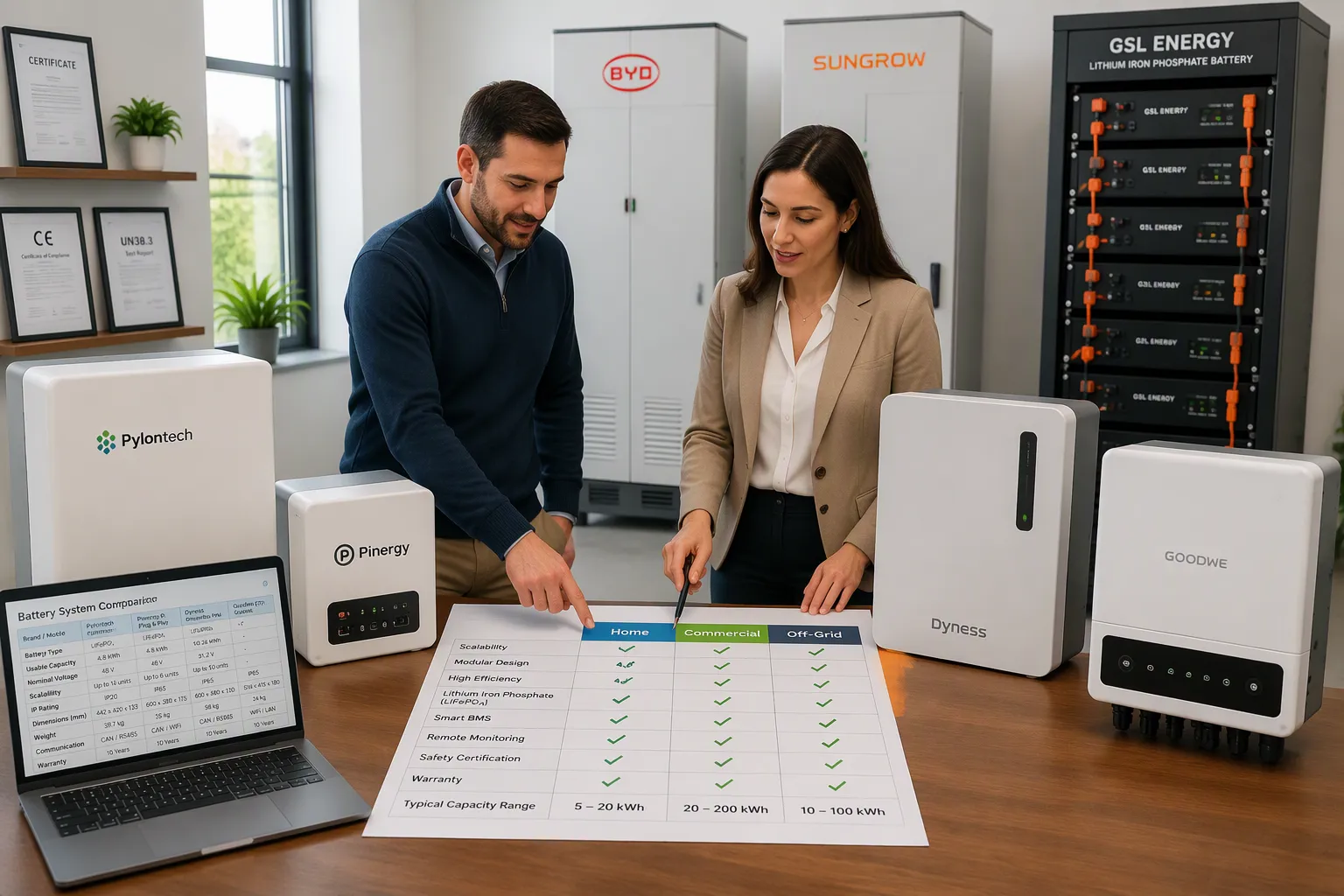
Homeowners need a battery that installs easily, pairs with common inverters, and carries local support. Pylontech earns the top pick for this category. The brand built its name on verified LFP cells for residential storage, and its 10-year warranty with 6,000 cycles at 95% depth of discharge gives buyers a clear benchmark. Pylontech batteries also work with most major inverters, which keeps installation simple.
Pinergy takes the runner-up spot. The company focuses on plug-and-play systems and responsive after-sales service. A homeowner who values fast warranty claims may prefer Pinergy over a larger brand with slower regional support. Dyness suits tight spaces, and GoodWe fits homes already using its inverters. Buyers comparing Solar Battery Manufacturers for a single-family home should shortlist these four before looking at utility-scale names.
Best For Commercial And Off-Grid
Commercial and off-grid projects demand larger capacity, stronger certifications, and integrated monitoring. BYD leads this category. Its vertical integration covers cell production through finished packs, and it overtook Tesla as the world's top BESS deployer in 2025 with over 60 GWh shipped. Sungrow ranks as the runner-up, combining inverters with storage and holding 9% of the 2025 global integrator market.
Buyers in markets with Huawei restrictions should avoid that brand and choose Sungrow instead. Off-grid users in remote areas should also weigh service access, since a failed pack far from a regional office creates real downtime.
Certified commercial options extend beyond the largest names. GSL ENERGY offers LiFePO4 systems certified to UL9540, UL1973, IEC62619, CEI-021, UN38.3, and CB/CE, with products spanning 186 kWh, 261 kWh, and 418 kWh cabinets, 80–140 kWh high-voltage cabinets, 143–315 kWh liquid-cooled systems, and 50–80 kW all-in-one units. The company reported deployments in more than 100 countries by mid-2025.
|
Brand |
Chemistry |
Certified Standards |
C&I Products (50 kWh–1 MWh) |
|---|---|---|---|
|
GSL ENERGY |
LiFePO4 |
UL9540, UL1973, CB/CE, UN38.3, IEC62619, CEI-021 |
186 kWh, 261 kWh, 418 kWh; 80–140 kWh HV cabinets; 143–315 kWh liquid-cooled; 50–80 kW all-in-one |
A buyer sourcing cells directly should request cycle-life data from any lithium battery supplier China candidate. A project developer should confirm inverter compatibility with the ESS manufacturer China before signing. These two checks prevent most integration problems.
BYD earns the top overall pick, with Sungrow as runner-up. Pinergy suits homeowners who value reliability and support. Buyers should weigh budget, project size, warranty, and trust concerns. These Solar Battery Manufacturers each serve different needs. Match the manufacturer to the situation rather than chasing the lowest price.
FAQ
Which Chinese solar battery brand suits a home?
Pylontech leads for homes. It offers a 10-year warranty and 6,000 cycles at 95% depth of discharge. Pinergy ranks second for responsive support.
Do Chinese batteries match Western brands on quality?
Major brands now hold international safety certifications and publish cycle-life data. Buyers should request cell origin and third-party audit reports from any lithium battery supplier China candidate.
How does a buyer verify a manufacturer before ordering?
Ask for cycle-life documentation, inverter compatibility data, and a local warranty service agreement. A reliable ESS manufacturer China partner answers these requests in writing.